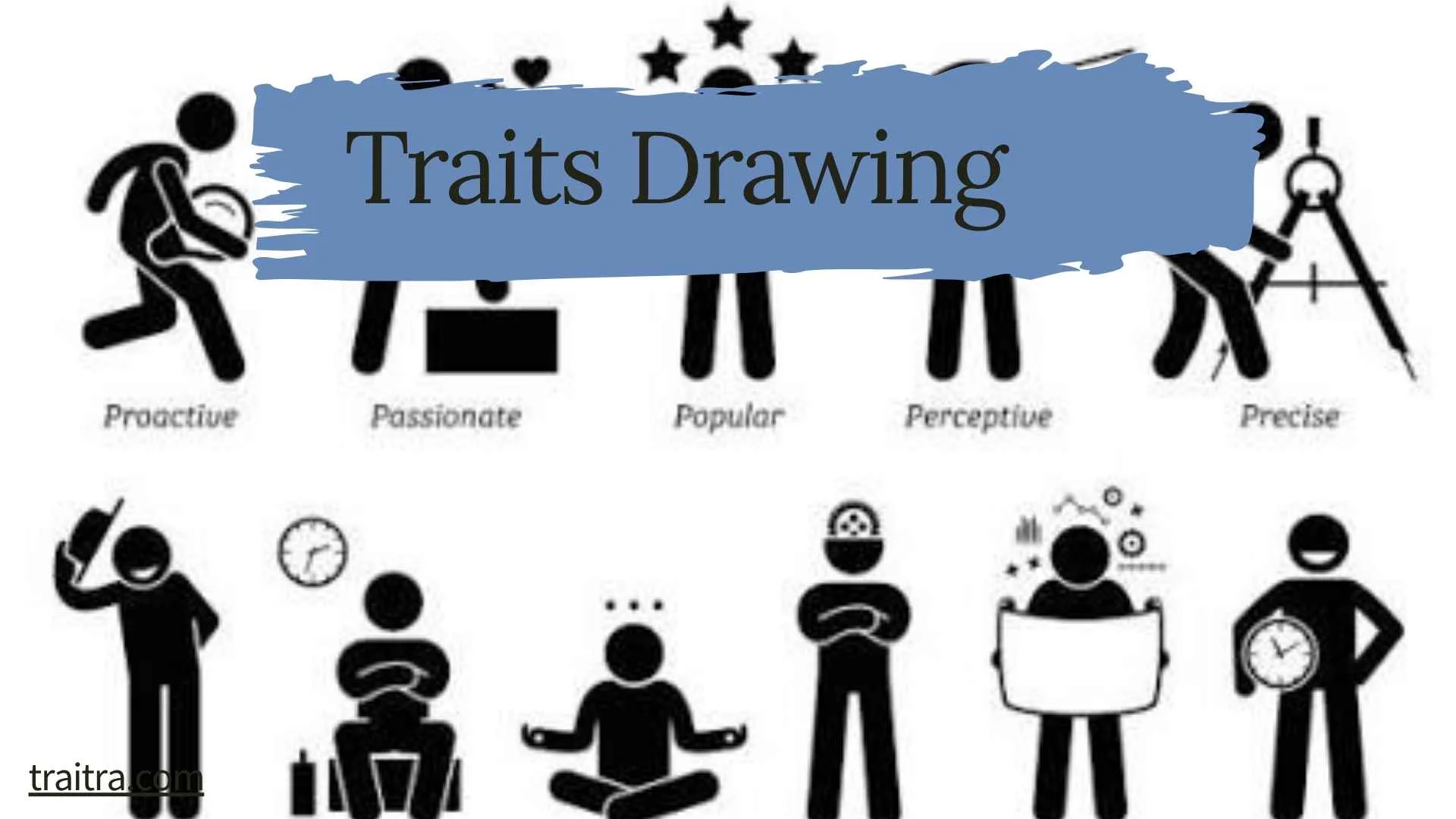
Traits drawing is a way to represent a person’s personality, character, emotions, or defining qualities through illustrations and visual symbols. It can include drawing character traits such as honesty, kindness, courage, creativity, and selfishness, or creating portraits and cartoon characters that show distinctive physical features and expressions.
If you are looking for traits drawing ideas for a school assignment, character education activity, art project, or creative illustration, the best approach is to connect each trait with a clear visual clue. For example, you could draw a person helping someone to represent kindness, a student facing a challenge to show courage, or a lightbulb above an artist’s head to represent creativity.
Understanding how traits can be shown through art makes it easier to communicate ideas without relying on long descriptions. This guide explains the different types of traits drawings, useful symbols, step-by-step drawing methods, creative examples, and tips for making your illustrations easy to understand.
traits drawing: Quick Answer
What is traits drawing?
Traits drawing is the practice of illustrating characteristics, qualities, or distinguishing features through pictures. Depending on the assignment, it may involve drawing personality traits, character traits, physical traits, emotional expressions, or fictional characters with recognizable qualities.
Common examples include:
- Kindness: A person helping a classmate.
- Honesty: Someone telling the truth.
- Courage: A person standing up for someone being bullied.
- Creativity: An artist imagining colorful ideas.
- Patience: Someone waiting calmly for a turn.
- Responsibility: A student completing homework or caring for a pet.
The key is to choose a recognizable action, expression, object, or symbol that communicates the intended trait.
Traits Drawing Overview Table
| Trait or concept | What to draw | What the drawing communicates |
| Kindness | Helping an elderly person | Care and compassion |
| Honesty | Returning a lost wallet | Truthfulness and integrity |
| Courage | Facing a difficult challenge | Bravery despite fear |
| Creativity | Painting an imaginative scene | Original thinking |
| Patience | Waiting calmly in line | Self-control |
| Responsibility | Feeding a pet | Dependability |
| Confidence | Speaking before a group | Belief in one’s abilities |
| Generosity | Sharing food with a friend | Willingness to give |
| Determination | Climbing a steep hill | Persistence toward a goal |
| Empathy | Comforting a sad friend | Understanding another person’s feelings |
| Curiosity | Examining a magnifying glass | Desire to learn |
| Leadership | Guiding a team | Helping others work toward a goal |
| Physical traits | Drawing curly hair or freckles | Visible appearance |
| Emotional expression | Drawing a smiling or worried face | A momentary emotional state |
These ideas work well for elementary school projects, middle school assignments, character education posters, storytelling, and beginner drawing exercises.
What Does Traits Drawing Mean?
Traits drawing means turning an abstract quality or a recognizable characteristic into a visual image. The exact meaning depends on the assignment: some teachers use the phrase for illustrations of personality and character, while artists may use it to describe the visual features that make a person or fictional character distinctive.
For example, drawing a person with round glasses and curly hair shows physical characteristics. Drawing that same person sharing a lunch with a classmate illustrates kindness through behavior.
A strong traits drawing usually has three parts:
- The trait: The quality you want to communicate.
- The visual clue: An action, expression, object, or feature that represents the quality.
- The explanation: A short caption that tells viewers why the image fits the trait.
This approach is useful in reading lessons, visual storytelling, character design, and classroom activities that connect art with personal values. The Lowell Milken Center’s character education lesson, for instance, encourages students to explore traits and values through discussion and artwork.
Lowell Milken Center
Types of Traits Drawings
Traits drawings can focus on several different kinds of characteristics. Identifying the right type before you start will help you choose the most suitable subject and drawing style.
1. Character Traits Drawing
Character traits describe qualities that influence how someone behaves and makes decisions. They are often used to describe people in books, stories, and real-life situations.
Popular character traits to draw include:
- Kindness
- Honesty
- Courage
- Respect
- Responsibility
- Loyalty
- Generosity
- Fairness
- Patience
- Determination
Drawing idea: Illustrate a student who finds a lost pencil case and returns it to its owner. Add the word honesty underneath. The action provides evidence for the trait instead of relying only on a label.
2. Personality Traits Drawing
Personality traits describe relatively consistent patterns in how people tend to think, feel, and behave. They are not the same as a person’s mood at a particular moment.
Examples include:
- Introversion
- Extraversion
- Curiosity
- Sociability
- Cautiousness
- Adaptability
- Assertiveness
- Openness to new experiences
Drawing idea: Create two fictional characters at a school event. One enjoys chatting with a large group, while the other prefers a quiet conversation with one friend. Both characters can be friendly; they simply express their social preferences differently.
Avoid treating these illustrations as strict rules. A quiet person can be confident, and an outgoing person can feel nervous in certain situations.
3. Physical Traits Drawing
Physical traits are visible or measurable features of a person’s appearance. They are useful when drawing portraits, designing fictional characters, or describing someone in a story.
Examples include:
- Hair texture and hairstyle
- Eye shape and color
- Freckles
- Facial features
- Height and body proportions
- Skin tone
- Dimples
- Distinctive clothing or accessories
Drawing idea: Draw a character with curly hair, round glasses, freckles, and a striped shirt. Label each feature with a small arrow.
Physical characteristics describe appearance; they do not automatically reveal personality, intelligence, morality, or ability.
4. Emotional Expression Drawing
Emotional expression drawings show how a character appears to feel at a particular moment.
9
Common expressions include happiness, sadness, surprise, anger, fear, confusion, and excitement.
You can communicate emotions by adjusting:
- Eyebrow position
- Eye shape and direction
- Mouth curvature
- Head position
- Shoulder posture
- Hand gestures
For example, raised eyebrows and an open mouth may suggest surprise, while lowered eyebrows and tightly pressed lips may suggest anger.
Remember that emotions and traits are different. A person may feel angry once without being an angry person by nature.
5. Fictional Character Traits Drawing
This type of illustration combines a character’s appearance with the qualities that shape the character’s decisions and actions.
A fictional detective might have a notebook, a magnifying glass, and an observant expression to suggest curiosity. A superhero might have a protective stance and help someone in danger to show courage and compassion.
When designing a character, consider:
- What does the character value?
- What does the character do when faced with a difficult choice?
- What visual details help communicate the character’s personality?
- What flaw or weakness makes the character believable?
A character who is brave but impatient, for instance, has more depth than a character who is simply labeled “brave.”
20 Traits Drawing Ideas for School and Art Projects
The following ideas are suitable for school worksheets, posters, sketchbooks, character maps, and drawing assignments. Each one connects a trait to a specific action so the meaning is easier to understand.
1. Kindness
Draw a child helping a classmate pick up books scattered across the floor. Show both characters smiling naturally.
Caption: “Kindness means helping others when they need it.”
2. Honesty
Draw a student returning a wallet that was found in the school hallway.
Caption: “Honesty means telling the truth and doing what is right.”
3. Courage
Draw a student speaking up when another child is being treated unfairly.
Caption: “Courage means doing the right thing even when it feels difficult.”
4. Creativity
Draw an artist imagining a scene filled with unusual buildings, floating islands, and colorful plants.
Caption: “Creativity means using imagination to develop new ideas.”
5. Patience
Illustrate a child calmly waiting for a turn at the school canteen.
Caption: “Patience means waiting without giving up or becoming unfair to others.”
6. Responsibility
Draw a child feeding a pet and refilling its water bowl.
Caption: “Responsibility means taking care of your duties.”
7. Confidence
Draw a student presenting a project while looking toward the audience.
Caption: “Confidence means trusting your ability to try and learn.”
8. Generosity
Show a child sharing a snack with a friend who forgot lunch.
Caption: “Generosity means being willing to share what you can.”
9. Determination
Illustrate a person climbing a challenging hill and continuing after a setback.
Caption: “Determination means continuing to work toward a goal.”
10. Empathy
Draw a child listening to a friend who feels upset.
Caption: “Empathy means trying to understand another person’s feelings.”
11. Curiosity
Draw a child examining a leaf, insect, or interesting rock with a magnifying glass.
Caption: “Curiosity inspires us to ask questions and explore.”
12. Leadership
Show a student organizing tasks and inviting classmates to contribute ideas.
Caption: “Leadership means helping a group work toward a shared goal.”
13. Respect
Draw two classmates listening to each other’s opinions without interrupting.
Caption: “Respect means treating people with consideration.”
14. Friendliness
Illustrate a child welcoming a new student into a group activity.
Caption: “Friendliness helps others feel welcome.”
15. Perseverance
Draw a young athlete practicing repeatedly after missing several shots.
Caption: “Perseverance means continuing to practice through setbacks.”
16. Fairness
Show children taking equal turns during a classroom game.
Caption: “Fairness means considering everyone’s rights and needs.”
17. Attention to detail
Draw a student checking measurements and recording results carefully during a science project.
Caption: “Attention to detail means noticing and checking important information.”
18. Self-control
Illustrate a child pausing to breathe instead of shouting after losing a game.
Caption: “Self-control means managing your reactions and choices.”
19. Accountability
Draw a student explaining an accidental mistake and offering to help fix the problem.
Caption: “Accountability means accepting responsibility for your actions.”
20. Cooperation
Show a group of children building a model together, with each person completing a different task.
Caption: “Cooperation means working together toward a common purpose.”
How to Draw Character Traits Step by Step
You do not need advanced drawing skills to create an effective traits illustration. A simple scene with a clear action and a useful caption can communicate a trait more effectively than a detailed picture with no obvious meaning.
Step 1: Choose one trait
Start with a single word, such as kindness, honesty, bravery, or patience. Avoid trying to represent five different qualities in one small picture.
Step 2: Plan a clear action
Ask yourself what a person might do to demonstrate the trait. For kindness, the person could help someone. For honesty, they could admit a mistake.
Step 3: Sketch basic shapes
Use circles for heads, lines for arms and legs, and simple shapes for the body. Add objects needed to explain the scene.
Step 4: Add expressions and gestures
Give the characters expressions and body positions that fit the scene. Keep in mind that facial expressions support the meaning but do not prove a person’s underlying character.
Step 5: Add color and a label
Use color to guide attention, not as a substitute for the action. Write the trait word beneath the image and add one sentence explaining the connection.
Materials You Can Use
For a basic school traits drawing, gather:
- Drawing paper or a sketchbook
- Pencil and eraser
- Colored pencils or crayons
- Black pen or marker for outlines
- Ruler, if you want a neatly arranged poster
- Optional reference images for poses and objects
If you are creating a digital illustration, a tablet or drawing application can replace the paper and pencils.
How to Make a Simple Drawing Look Better
- Make the main action large enough to recognize.
- Use a clear foreground and background.
- Include only the objects needed to explain the idea.
- Keep labels short and easy to read.
- Use contrasting colors to separate the main subject from the background.
- Check whether someone can guess the intended trait before reading the caption.
The most important improvement is clarity. A viewer should be able to connect the character’s action to the trait without having to guess what is happening.
Best Symbols for Drawing Different Traits
Symbols can make traits drawings easier to understand, especially when you have limited space for a poster, worksheet, or presentation.
| Trait | Possible symbol | How to use it |
| Honesty | Open book or clear mirror | Pair it with a truthful action |
| Courage | Shield or mountain | Show someone facing a challenge |
| Kindness | Helping hands | Draw hands assisting another person |
| Creativity | Lightbulb or paintbrush | Show a new idea becoming a creation |
| Curiosity | Magnifying glass | Draw someone investigating an object |
| Patience | Clock or growing plant | Show waiting or steady progress |
| Responsibility | Checklist | Show completed tasks |
| Empathy | Two connected hearts | Pair it with listening or comfort |
| Cooperation | Interlocking pieces | Show people contributing to a shared task |
| Determination | Stepping stones | Illustrate progress toward a goal |
| Fairness | Balanced scales | Show equal consideration |
| Leadership | Compass | Illustrate guidance toward a shared goal |
These symbols are suggestions, not universal meanings. A heart may communicate love or compassion, while a compass can suggest guidance or direction. The surrounding scene and caption help viewers understand your intended meaning.
How to Draw a Character Trait Map
A character trait map is a visual organizer that places a character in the center and connects the character to words, actions, feelings, and other details. It is especially useful for reading comprehension, book reports, and creative writing assignments.
To make one, follow these steps:
- Draw a portrait or a simple character in the center of the page.
- Add four to six trait words around the character.
- Draw arrows connecting each trait to a specific action or story detail.
- Add small illustrations beside the actions.
- Write a short explanation showing why each action supports the trait.
For example, a character who finds a lost wallet, returns it, and tells the truth about where it was found may demonstrate honesty and responsibility. One event can provide evidence for more than one trait.
A useful variation is the “trait evidence map,” in which every trait must connect to an observable action. This prevents students from choosing descriptive words without explaining why they fit.
Teachers can also use character maps to connect drawing with reading and writing instruction. Scholastic describes character mapping as a way for young readers to explore traits and develop their understanding of story characters.
Teachers
Character Traits Drawing vs. Personality Traits Drawing
Character traits and personality traits overlap, but they emphasize different aspects of a person. A drawing assignment may use either term, so understanding the distinction helps you select the right scene.
| Feature | Character traits drawing | Personality traits drawing |
| Main focus | Values, choices, and moral qualities | Typical patterns of thinking, feeling, and behaving |
| Examples | Honesty, fairness, loyalty | Sociability, cautiousness, adaptability |
| Best visual approach | A meaningful decision or action | A recurring preference or behavior |
| School use | Character education and literature | Self-awareness and personality exploration |
| Example | A student admits to breaking a classroom rule | A student prefers to observe before joining a group |
Neither category is completely separate from the other. Honesty can be discussed as a character quality and a relatively consistent behavioral tendency. The purpose of the assignment determines which interpretation is most useful.
Positive, Negative, and Neutral Traits
Traits can also be grouped by how people commonly evaluate them.
| Category | Examples | Drawing idea |
| Positive traits | Kindness, courage, fairness | A person helping someone in need |
| Negative traits | Dishonesty, cruelty, arrogance | A character taking credit for someone else’s work |
| Context-dependent traits | Cautiousness, competitiveness, assertiveness | A character carefully weighing a risky decision |
The last category is particularly important. Traits such as stubbornness, competitiveness, and cautiousness can have both helpful and harmful effects depending on the situation.
For instance, competitiveness can motivate an athlete to practice harder, but it can also damage teamwork when winning becomes more important than fair play.
A balanced traits drawing should explain the behavior rather than simply labeling a person as good or bad.
Internal Traits vs. External Traits
Internal traits describe qualities that are not directly visible, while external traits refer to observable physical characteristics. Artists often combine the two when designing characters.
| Aspect | Internal traits | External traits |
| Meaning | Qualities, tendencies, and values | Physical appearance |
| Examples | Curiosity, patience, integrity | Freckles, hair texture, eye color |
| How to draw them | Show actions, decisions, or symbols | Draw visible features and details |
| Evidence | Behavior across situations can provide clues | Direct visual observation |
| Common mistake | Assuming an expression proves a personality trait | Assuming appearance reveals character |
Consider a fictional student with glasses and curly hair who carefully helps classmates solve problems. The glasses and hair are external features; the helpful behavior provides evidence of kindness.
This distinction is useful for both art and storytelling because it encourages artists to build characters with individual appearances and meaningful behavior rather than relying on stereotypes.
How Artists Show Personality Through Character Design
Artists can suggest personality through body language, clothing, posture, facial expressions, color, and repeated visual details. However, these are creative choices rather than reliable tests of a real person’s character.
14
Facial Expressions
Facial expressions help communicate what a character may be feeling at a particular moment.
- Raised eyebrows can suggest surprise or curiosity.
- A relaxed smile can suggest warmth or happiness.
- A furrowed brow can suggest concentration, worry, or frustration.
- Direct eye contact may suggest engagement, depending on the character and situation.
Do not rely on one expression to communicate a complex trait. A smiling character is not necessarily kind, and a serious character is not necessarily unfriendly.
Body Language and Posture
Body posture gives viewers additional information about a scene.
A character leaning forward while listening can suggest interest. A character carefully holding a broken object while explaining what happened may communicate accountability. A person standing beside a nervous teammate may convey support.
Use posture to reinforce the story instead of treating a particular pose as proof of a personality type.
Clothing and Accessories
Clothing can help establish a character’s role, interests, background, or setting. A painter may carry brushes, a scientist may hold a notebook, and a fictional explorer may wear a backpack.
These details work best when they connect to the character’s activities or story. Avoid suggesting that expensive clothing, a particular body type, or a specific appearance determines whether someone is trustworthy, intelligent, or kind.
Color and Visual Mood
Color can influence how a drawing feels. Bright colors may create an energetic mood, while muted colors can create a quiet or reflective atmosphere.
Still, color meanings vary by culture, context, and artistic style. Red does not always mean anger, and blue does not always mean sadness. Choose colors based on the scene you want to communicate.
12 Real-Life Scenarios You Can Turn Into Traits Drawings
These scenarios offer more specific ideas than simply drawing a face beside a trait word. Each one shows a situation in which a characteristic becomes visible through a choice or action.
| Scenario | Trait illustrated | What to include in the drawing |
| A student helps a new classmate find the classroom | Friendliness | Two students and a classroom sign |
| An employee admits a mistake in a report | Accountability | A report with a corrected entry |
| A child practices tying shoelaces after several attempts | Perseverance | Untied and successfully tied shoes |
| A teammate passes the ball to someone in a better position | Cooperation | Two players working together |
| A student asks why a science experiment failed | Curiosity | A notebook and an experiment setup |
| A person returns extra change received at a store | Honesty | A cashier and returned coins |
| A sibling listens without interrupting | Respect | Two people in conversation |
| A child saves part of an allowance for a goal | Self-discipline | A savings jar and a goal chart |
| A group changes its plan after a project problem | Adaptability | An original plan and a revised plan |
| A student thanks a classmate for useful feedback | Humility | Two students reviewing a project |
| A person checks both sides before crossing a road | Cautiousness | A pedestrian and a crosswalk |
| A team captain asks every member for ideas | Inclusive leadership | A group sharing suggestions |
A Simple Example: Drawing Honesty
Imagine that your assignment asks you to illustrate honesty.
Instead of drawing a person with a halo or simply writing “honest” above a portrait, create a small scene:
- A student accidentally damages a classroom book.
- The student tells the teacher what happened.
- The student offers to repair or replace the damaged item.
- A caption explains the connection between the choice and honesty.
The scene communicates more than a symbol alone because it shows the situation, decision, and consequence.
You can use the same method for almost any trait. Identify the situation, show the choice, and explain the quality that the choice demonstrates.
Traits Drawing Activities for Different Age Groups
The best activity depends on the learner’s age, drawing experience, and assignment requirements. Younger students often benefit from simple actions and clear labels, while older students can explore mixed traits, symbolism, and character development.
Preschool and kindergarten
Choose familiar traits such as kindness, sharing, patience, and helpfulness. Use simple figures, large shapes, and one-sentence captions.
Activity: Draw a helping hand and add one example of how you help at home or school.
Elementary school
Connect character words to concrete actions. Students can draw a scene from a story and explain how the character demonstrates a quality.
Activity: Draw three scenes showing honesty, courage, and responsibility.
Middle school
Explore internal traits, conflicting qualities, and character development. Include evidence from a story or a realistic scenario.
Activity: Design a character who is both ambitious and impatient, then illustrate how those traits affect a decision.
High school, college, and advanced artists
Use visual symbolism, subtle gestures, contrasting motives, and changes in appearance across a narrative.
Activity: Create a three-panel sequence showing how a character’s confidence changes from doubt to a difficult but successful action.
Teachers can adapt these exercises to reading, writing, visual arts, and social-emotional learning. The University of California, Berkeley’s Greater Good in Education program also offers art-based activities that connect creative expression with self-awareness and social awareness.
Greater Good In Education
Common Misconceptions About Traits Drawing
Understanding these common mistakes will help you create clearer, more thoughtful illustrations.
Myth 1: A Trait Must Be Shown With a Symbol
Fact: Symbols are optional. A meaningful action can communicate a trait more clearly than a heart, shield, or lightbulb.
A person returning a lost item demonstrates honesty directly. A heart symbol may suggest kindness, but it needs context to explain what the character is doing.
Myth 2: One Action Proves Someone’s Entire Character
Fact: A single action provides evidence about a particular moment, but it does not necessarily establish a permanent trait.
A normally quiet student might speak confidently during a presentation. A usually impatient person might wait calmly when someone needs help. Show the behavior accurately without assuming it tells the whole story.
Myth 3: Personality Traits and Feelings Are the Same
Fact: Feelings can change quickly, while personality traits generally refer to more consistent patterns.
A person can feel nervous before a presentation without being a fearful person in every situation. If your assignment concerns courage, show the person taking a meaningful action despite feeling nervous.
Myth 4: Negative Traits Make a Character Bad in Every Situation
Fact: Most traits need context. Stubbornness can prevent someone from accepting useful advice, but persistence can also help a person continue working toward a difficult goal.
Illustrating the consequences of a trait creates a more realistic and interesting character.
Myth 5: Appearance Reveals Personality
Fact: Physical features do not reliably establish a person’s moral character or personality.
An artist can create a fictional visual style to suggest a character’s role, but a person’s hairstyle, skin color, clothing, or facial features should not be treated as proof of honesty, intelligence, kindness, or trustworthiness.
Myth 6: A Good Traits Drawing Must Be Complicated
Fact: A simple illustration can communicate an idea effectively when the action is clear.
A few lines showing someone helping another person may communicate kindness more successfully than a detailed drawing filled with unrelated objects.
Common Mistakes to Avoid
Before submitting your drawing, check for these problems:
- Too many traits in one image: Focus on one main trait or make each trait clearly identifiable.
- Unclear action: Make sure viewers can tell what the character is doing.
- Missing explanation: Add a short caption if the intended meaning is not immediately obvious.
- Unnecessary decoration: Keep backgrounds and extra objects from distracting attention.
- Confusing emotions with character: Show the action or pattern that supports the intended trait.
- Stereotyped character design: Avoid linking physical appearance to moral or intellectual qualities.
- Poor readability: Use labels that are large enough to read and place them close to the relevant illustration.
- No connection to the assignment: If your teacher asks for evidence from a book, use an actual scene or event from the story.
A useful final test is to cover the caption and ask someone what trait the drawing communicates. If the answer differs from your intended meaning, adjust the action or add a clearer visual clue.
Related Traits to Explore Through Drawing
If you want to expand your project, the following related topics offer more ideas for illustrations, worksheets, and character design.
- Character Traits: Draw honesty, kindness, loyalty, bravery, and other qualities through actions.
- Personality Traits: Illustrate curiosity, sociability, adaptability, and cautiousness.
- Positive and Negative Traits: Compare helpful and harmful choices in similar situations.
- Emotional Traits and Expressions: Explore how facial expressions, posture, and gestures communicate feelings.
- Leadership Traits: Show teamwork, decision-making, accountability, and guidance.
- Animal Traits: Illustrate visible animal features and recognizable behaviors without assuming every animal behaves identically.
- Fictional Character Design: Combine appearance, personality, strengths, weaknesses, and personal goals.
- Character Analysis in Literature: Connect a character’s words, thoughts, actions, and decisions to evidence from a story.
These topics can become separate art projects or work together in a larger character education portfolio.
Frequently Asked Questions
1. What is a traits drawing?
A traits drawing is an illustration that communicates a characteristic through an action, visual feature, expression, or symbol. It can focus on personality, character, physical appearance, or emotional expression, depending on the assignment.
2. What are the easiest traits to draw?
Kindness, honesty, courage, patience, responsibility, and creativity are among the easiest traits to illustrate because they can be represented through familiar actions. For example, draw a student sharing supplies to show generosity or a child caring for a pet to show responsibility.
3. How do you draw character traits for a school assignment?
Choose one trait, identify an action that demonstrates it, sketch the people and objects involved, and add a short caption. If the assignment is based on a book, choose an event that actually happens in the story and explain how it supports your interpretation.
4. What is the difference between a trait and an emotion in a drawing?
An emotion is a feeling that may change from moment to moment, while a trait generally refers to a more consistent quality or behavioral tendency. A worried face shows possible worry at a particular moment; repeatedly making careful choices in uncertain situations may suggest cautiousness.
5. Can I draw negative character traits?
Yes. You can illustrate jealousy, dishonesty, selfishness, arrogance, impatience, or other undesirable qualities. Show the relevant behavior and its consequences without suggesting that one mistake defines a person’s entire identity.
6. How can I show kindness without using a heart symbol?
Draw a person listening to a friend, helping someone carry a heavy bag, sharing supplies, or including a new student in a game. The action itself can communicate kindness without any symbolic decoration.
7. What should I write under a traits drawing?
Use the trait name followed by one clear sentence explaining its meaning. For example: “Perseverance means continuing to work toward a goal even when progress is difficult.”
8. How do I draw multiple character traits in one picture?
Create a character map or a scene with several distinct actions. For instance, a student helping a classmate, admitting a mistake, and completing a group task might demonstrate kindness, honesty, and responsibility. Label each action so the connections remain clear.
9. Are traits drawings useful for literature assignments?
Yes. They help readers connect character descriptions to evidence from a story. Students can draw a character, label relevant traits, and add examples of the character’s dialogue, decisions, and behavior. This also supports narrative writing and character analysis.
Yale-New Haven Teachers Institute
+1
10. How can I make a traits drawing more creative?
Use a visual metaphor, a short comic strip, a character map, or a before-and-after scene. For example, show determination through a character practicing a difficult skill in three panels, with each panel showing progress toward a goal.
11. What is a good traits drawing idea for beginners?
Draw two simple figures and one clear action. A child helping another child pick up books is an easy starting point because the action, relationship, and intended trait are straightforward.
12. Can traits drawings be created digitally?
Yes. You can create them with a drawing tablet, illustration software, or a basic digital sketching application. Use layers for the sketch, outlines, colors, labels, and background so you can edit each element separately.
13. How many traits should I include in a drawing?
For a simple assignment, one main trait is often enough. A character map or poster can include several traits if each one has a clear example or visual connection.
14. Do colors have fixed meanings in traits drawings?
No. Colors can suggest a mood or reinforce an idea, but their meanings are not universal. Use the scene, character actions, and captions to communicate the intended trait instead of relying on color alone.
15. How do I choose the right trait for my drawing?
Start with the assignment’s instructions. If the task concerns a story, select a trait supported by the character’s actions. If it concerns personal values, choose a quality you can illustrate through a familiar situation. If it concerns appearance, focus on visible physical characteristics.
Key Takeaways
- Traits drawing turns characteristics and qualities into visual stories.
- Character traits often work best when shown through actions and decisions.
- Personality traits describe broader behavioral patterns, while emotions describe momentary feelings.
- Physical traits concern appearance and should not be confused with moral or personality qualities.
- Symbols, facial expressions, body language, and captions can make an illustration easier to understand.
- A simple drawing with a clear action can be more effective than a complicated picture.
- Character maps and comic strips are useful formats for showing several traits.
- For literature assignments, connect every trait to specific evidence from the story.
- Avoid stereotypes and remember that people can demonstrate different qualities in different situations.
Conclusion
Traits drawing is a creative way to explore personality, character, appearance, and behavior through art. Whether you are completing a school assignment, designing a fictional character, or creating a character education poster, the most effective approach is to connect each trait with a recognizable visual clue.
Start with an idea such as kindness, honesty, courage, curiosity, or determination. Choose a scene that communicates the quality, sketch the main action, and add a short explanation. For more advanced projects, use character maps, visual metaphors, and contrasting scenes to show how different traits influence decisions.
The best traits drawings do more than label a characteristic. They help viewers understand what the trait means, how it appears in a real situation, and why the character’s actions matter.

I am Theo Harrington, a writer interested in the fascinating differences that shape human personality and character. I explore positive traits, challenging behaviours, emotional qualities, and personal growth. My goal is to share useful knowledge that encourages readers to understand personality better and appreciate what makes people truly unique.
Books:
- Traits That Define Us
- The Modern Guide to Understanding Character